How to Change HOA Management Companies Smoothly: The Step-by-Step Guide
How to Change HOA Management Companies Smoothly: The Step-by-Step Guide
It usually starts with a quiet pattern of frustration. An email about a broken community gate goes unanswered for a week. A financial report arrives late, missing critical line items. A vendor relationship strains because bills aren’t being paid on time.
As an HOA board member, you volunteered to protect property values and build a harmonious neighborhood—not to chase down the professional management company you hired to help you.
Yet, many boards tolerate subpar communication, financial opacity, and organizational chaos for months, or even years. Why? Because of fear. The thought of moving bank accounts, historical records, and homeowner rosters feels like an operational nightmare that will disrupt the entire community.
But it doesn’t have to be. Changing providers is entirely manageable when you use a systematic approach. Here is your step-by-step roadmap on how to change HOA management companies smoothly and transition to a partner that actually delivers on its promises.
1. Review Your Current HOA Management Contract
Before you drop hints or make phone calls to prospective management firms, you must understand the legal and financial boundaries of your existing agreement. Pull out your current contract and examine it through a strict timeline lens.
Look for Termination and Renewal Clauses
The most common trap for HOA boards is the automatic renewal clause. Many contracts state that if you do not provide notice within a very specific window (often 60 or 90 days before the contract’s expiration date), the agreement automatically locks in for another full year. Mark these dates clearly on your calendar. You will also need to determine the required notice period for termination “without cause”—which is typically 30 to 60 days.
Identify Termination Fees or Penalties
If your current company is severely failing in their fiduciary duties, you may look into termination “with cause.” However, this often requires proving a material breach of contract, which can lead to legal complications. If you choose to terminate early without cause, calculate any potential financial penalties. In many cases, paying a short-term fee to exit a destructive management relationship is well worth the long-term protection of your community’s financial health.
2. Form a Dedicated Transition Committee
Transitioning shouldn’t be a solo burden placed on the board president. It requires a coordinated team effort. By establishing a temporary transition committee, you split up the workload and keep the process highly organized.
Assign specific oversight roles to your board members:
- Legal & Contract Review: Verifies notice timelines and ensures compliance with your community’s bylaws.
- Data & Records Liaison: Coordinates directly with the outgoing and incoming managers to track asset delivery.
- Community Communications: Handles all official messaging to the homeowners to keep the neighborhood informed and calm.
Establish a realistic timeline. A rushed transition causes gaps in service. Aim for a 60-to-90-day transition window from the day you issue your termination notice to the day the new company officially takes the reins.
3. Draft a Clear Request for Proposal (RFP)
When looking for a new management partner, do not simply ask for a generic price sheet. If you don’t define exactly what your community needs, you risk repeating the same mistakes with a different company.
Draft a detailed Request for Proposal (RFP) that explicitly outlines your community’s specific pain points. For example:
- If communication was the issue, mandate a contractually guaranteed response-time window (e.g., all non-emergency board emails answered within 24 hours).
- If financial reporting was messy, require a specific monthly delivery date for financial packages.
- If you are located in the Carolinas, ensure the prospective firm possesses deep, localized compliance knowledge regarding North or South Carolina community association statutes.
Look for firms that assign a dedicated, certified community manager to your property, rather than forcing you into a randomized call-center pool.
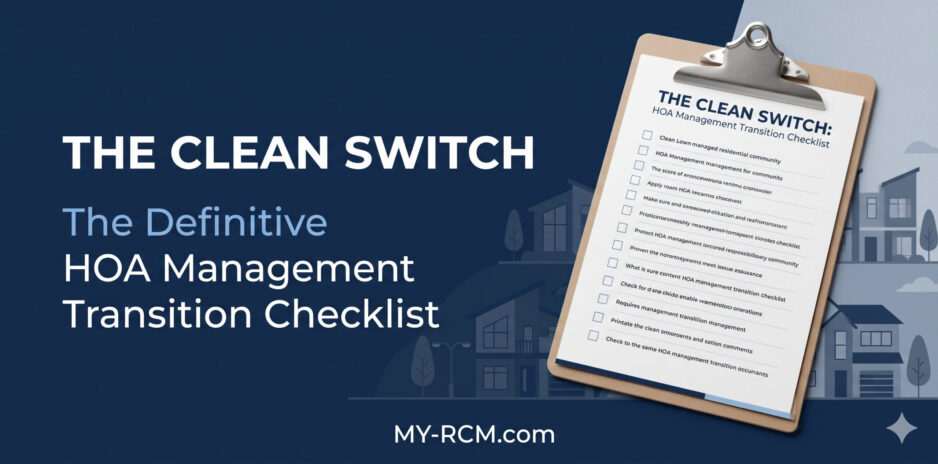
4. The HOA Management Transition Checklist: What Data Needs to Move?
The biggest source of anxiety during a management shift is data loss. A professional incoming management company will do the heavy lifting for you, but your board must verify that everything crosses the finish line securely. Use this phased HOA management transition checklist to track your digital and physical assets.
Phase 1: Secure the Financial Accounts
Transfer all operating bank accounts, reserve funds, tax returns, historical audit records, and the current fiscal year-to-date general ledger. Ensure new banking signatures are authorized and old ones are promptly revoked.
Phase 2: Export Community Data
Retrieve the complete, up-to-date homeowner roster (including off-site owners and renters), current account balances, active covenant violation histories, and open architectural control (ARC) requests.
Phase 3: Transfer Historical Records
Gather past board meeting minutes, signed resolutions, original governing documents (CC&Rs, bylaws), insurance policies, and active vendor contracts. For long-term financial health, benchmarking your operational costs against regional averages—such as reviewing strategies for reducing neighborhood vendor costs—can ensure your contracts remain competitive during this handoff.
Phase 4: Hand Over Digital Access
Revoke the outgoing company’s administrative privileges to community websites, neighborhood portals, social media pages, domain registries, and smart gate or amenity access systems, transferring total control to the incoming team.
5. Communicate Proactively with Homeowners
When a management change occurs, rumors can quickly breed anxiety among neighbors. Homeowners might worry about spikes in dues, lost payments, or general neighborhood instability. You must control the narrative by communicating transparently.
Do not send a vague alert the moment you start thinking about switching. Wait until the new contract is signed and the timeline is locked. Then, issue an official letter containing two critical pieces of information that residents actually care about:
- Where do I pay my assessment next month? Provide explicit instructions on when the old payment portal closes and how to set up automatic drafts or mail checks to the new management firm.
- Who do I contact for maintenance or emergencies? Provide the new phone numbers, email addresses, and portal links.
Consider hosting a digital welcome town hall or distributing a brief onboarding welcome packet in partnership with your new management company to introduce the team and answer immediate resident questions.
6. Execute the Hand-Off and Offboarding
Once your ducks are in a row, it’s time to take the formal step. Issue your HOA termination of contract notice exactly according to the method prescribed in your agreement. To protect your board legally, ensure this notice aligns precisely with your state’s planned community regulations, such as the North Carolina Planned Community Act or the corresponding statutes in South Carolina.
Once the notice is received, the transition window officially opens. Top-tier community management firms employ dedicated onboarding managers whose sole job is to coordinate directly with your outgoing provider. They will systematically pull the data, integrate your financials into their platform, and ensure that on day one, the switch feels seamless to your neighborhood.
The Bottom Line: A smooth transition does not happen by accident; it requires a systematic checklist and a proactive board. But sticking with an unresponsive, disorganized management company out of fear of change only places your community’s finances and property values at long-term risk.
Is your board ready to experience transparent financial reporting, proactive maintenance, and responsive communication? Contact Revelation Community Management (My-RCM) today for a confidential, no-obligation contract review and transition consultation. We help communities across the Carolinas navigate this process cleanly, ensuring your neighborhood never misses a beat.