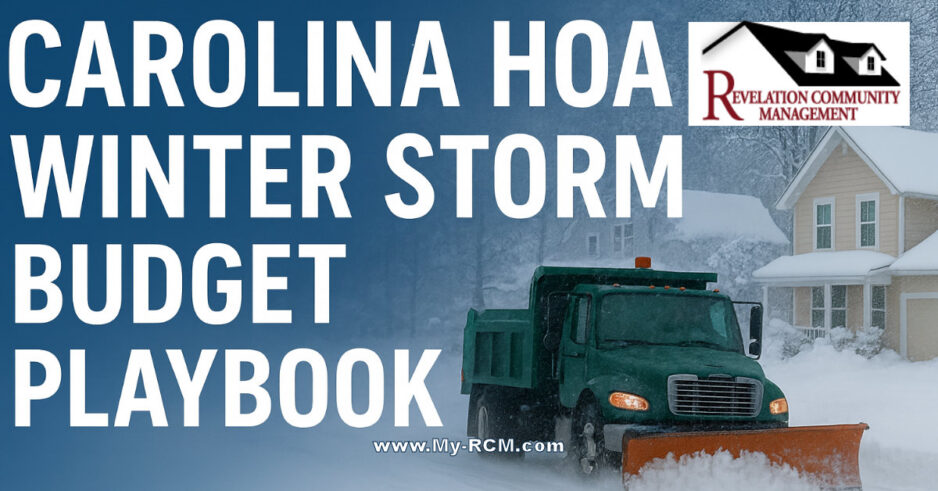
Carolina HOA Winter Storm Budget Playbook
Practical guidance for HOAs in Charlotte, Weddington, Huntersville, Matthews, Pineville, Rock Hill, Lake Wylie, Clover, and York.
Why Carolina HOAs Need a Winter-Storm Budget
While heavy snow is less frequent in the Carolinas than in northern states, even a light snowfall or ice event can disrupt a community, damage property, and create safety liability. HOA boards in Charlotte, Weddington, Huntersville, Matthews, Pineville (NC) and Rock Hill, Lake Wylie, Clover, York (SC) must be prepared with a clear winter-storm budget and operational plan so the community stays safe, walkways and roads remain passable, and unexpected expenses don’t derail reserves.
Step-by-step: How to Set a Winter-Storm Budget for Your HOA
- Review recent history. Look at the past 5–10 years of winter-related expenses: snow removal, de-icing, tree/branch clean-ups, emergency vendor calls, and extra staff hours. Use those figures as a baseline and then add a contingency.
- Estimate likely events, not extremes. Budget for the types of events most likely in the Piedmont and Lowcountry—ice, light snow, freezing rain, downed limbs—and plan separately for rare major storms.
- Itemize costs:
- Contracted plowing & de-icing (roads, common drives, parking areas)
- Walkway clearing (contractors or hourly staff)
- Emergency tree removal and debris hauling
- Temporary lighting, signage, and barricades
- Insurance deductibles and emergency admin expenses
- Get multiple vendor quotes and hold them on retainer. Ask at least three local vendors for winter-service pricing and service-level agreements (SLAs). Retainer fees are often cheaper than one-off emergency calls during a storm.
- Include a contingency (recommended 20–40%). Because storms are unpredictable, add a contingency line so the HOA doesn’t scramble for assessments mid-season.
- Set reserve vs. operating splits clearly. Decide which expenses are operating (day-to-day snow/ice clearing) and which could come from reserves (major storm repairs, infrastructure damage). Document this in your budget notes.
- Plan for communication costs. Budget for rapid notifications (email/SMS systems), signage, and staffing to coordinate vendor access and resident safety notices.
Carolinas-Specific Tips for HOAs
- Understand local microclimates. Coastal-influenced areas (near Lake Wylie and other waterways) may face freezing rainfall and localized flooding. Urban centers like Charlotte can develop icy bridges and overpasses quickly—plan treatment routes accordingly.
- Protect irrigation and landscaping. Budget for pre-storm irrigation shutdowns and post-storm inspections—freeze-thaw cycles can damage systems common in Matthews and Huntersville neighborhoods.
- Tree maintenance is essential. Southern oaks and pines in Clover and Rock Hill can snap under ice weight—budget preventative pruning and pre-storm hazard tree assessments.
- Use regionally experienced vendors. Hire vendors who understand Carolinas storms—local contractors know which residential roads and HOA entrances need priority attention in towns like Pineville and Weddington.
- Coordinate with nearby communities. Smaller HOAs (especially in York and Lake Wylie areas) may save money by pooled contracts for equipment and bulk de-icing materials.
Operational Checklist — From Planning to Post-Storm
Turn your budget into a ready-to-execute plan:
- Create a prioritized clearing map for roads, mail centers, sidewalks, and emergency vehicle access.
- Negotiate SLAs with response times and performance metrics.
- Keep a list of resident mobility needs and critical access points (e.g., assisted living residents in community).
- Stock basic supplies: sand/salt alternatives safe for Carolina vegetation, portable signage, and temporary barricades.
- Schedule annual pre-winter vendor reviews and a post-storm debrief to refine budgets for next year.
Budget Template (Quick Example)
Below is a simple breakdown to adapt to your HOA size and risk profile:
- Baseline contractor services (plow/de-ice): enter your quote
- Walkway clearing / hourly labor: enter estimate
- Emergency tree/landscape cleanup: 25% of baseline
- Communication & admin: 5–10% of baseline
- Contingency reserve: 20–40% of subtotal
Tip: run two scenarios — a “likely” scenario and a “rare severe” scenario — to test reserve adequacy.
Funding Options & Board Governance
Boards may fund winter readiness through the operating budget, transfer from reserves, or (as a last resort) a special assessment. Best practices:
- Keep the decision transparent: present historical numbers and vendor quotes at a board meeting.
- Adopt a written winter policy that clarifies vendor priority, homeowner responsibilities, and how costs are allocated.
- Document every vendor contract and invoice for ease of audit and member communication.
Why Choose Revelation Community Management?
If your HOA in the Carolinas wants a practical, experience-driven partner for budgeting, vendor management, and emergency coordination, look no further than Revelation Community Management. We specialize in local HOA needs across North and South Carolina and can:
- Help you build a realistic winter-storm budget tailored to your community and risk profile.
- Negotiate and manage SLAs with reliable, regionally experienced contractors.
- Run yearly preparedness reviews and post-storm financial reconciliations.
- Provide resident communications and emergency coordination so boards can focus on governance.
Next Steps — Practical To-Dos for Your Board This Quarter
- Gather last 5 years of winter-related line items and create a simple spreadsheet.
- Request 3 vendor bids and add a contingency line to the draft budget.
- Schedule a vendor vetting session and resident-info update before the first freeze.
- Consider a joint contract with neighboring HOAs if your community is small.