Navigating HOA Budget Season: A Q4 Guide for Carolina Boards
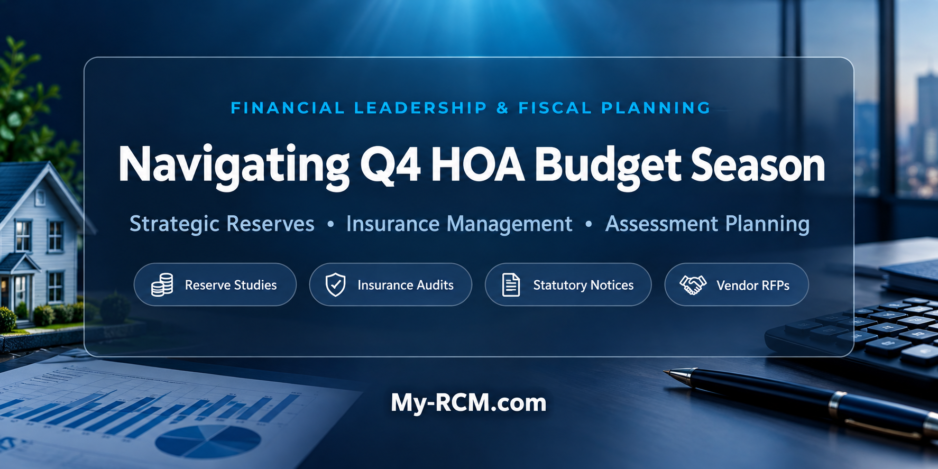
Navigating an HOA budget during Q4 requires more than balancing income and expenses. Carolina HOA boards need to forecast insurance costs, review operating expenses, evaluate reserve funding, determine whether assessment increases are necessary, and communicate those decisions before residents are surprised by higher dues. A disciplined process turns budget season into a financial planning exercise rather than a homeowner backlash event.
For boards in Charlotte, Weddington, Huntersville, Matthews, and Pineville, the fourth quarter is an important opportunity to look beyond the next twelve months and build a sustainable financial plan. North Carolina’s Planned Community Act provides the statutory framework for many planned communities, while each association’s declaration, bylaws, and other governing documents may impose additional requirements. Boards should review those documents and obtain legal advice when a specific compliance question arises.
Navigating HOA Budget Planning Starts With the Numbers
The first step in navigating HOA budget season is to establish a reliable financial baseline. Do not begin by deciding how much assessments should increase. Begin by determining what the association actually needs to operate, maintain common areas, protect its insurance position, and prepare for future capital expenses.
Build a Q4 Financial Snapshot
Before drafting the new budget, gather the current year’s financial information and compare the approved budget with actual results. Look for recurring expenses that were underestimated, contracts that have increased in price, maintenance categories that are consistently over budget, and revenue assumptions that did not materialize.
- Current operating account balance
- Current reserve balance
- Year-to-date income and expenses
- Outstanding homeowner assessments
- Vendor contracts and renewal dates
- Insurance premiums and deductibles
- Expected maintenance and capital projects
- Reserve study recommendations
- Legal, accounting, and management expenses
This financial snapshot gives the board a factual starting point instead of relying on assumptions or last year’s budget.
Step 1: Separate Operating Costs From Reserve Needs
One of the most important navigating HOA tips is to avoid treating operating expenses and reserves as one large pool of money. Operating funds generally support the association’s ongoing expenses, while reserves are intended for significant future repair and replacement obligations.
A reserve study can help the board understand the expected useful life and replacement costs of major components. The Community Associations Institute describes reserve studies as a tool for planning repair and replacement costs and reducing the likelihood of large, unexpected special assessments.
Create a Reserve Funding Road Map
Review the association’s major components and identify which expenses may occur within the next several years. Depending on the community, that could include roads, roofs, fencing, pools, clubhouses, drainage systems, landscaping infrastructure, lighting, or other common elements.
- Identify the component.
- Estimate its remaining useful life.
- Estimate its future replacement cost.
- Compare the projected need with current reserve funding.
- Determine the annual contribution needed to stay on track.
- Document any funding gap and the board’s plan to address it.
The objective is not simply to accumulate the largest possible reserve balance. It is to create a funding strategy that matches the association’s expected obligations and governing requirements.
Step 2: Prepare for Insurance Surges Before Setting Assessments
Insurance can dramatically change the Q4 budget calculation. Community associations have faced higher premiums, changing coverage availability, increased deductibles, and more complicated insurance markets. CAI reported that 91% of surveyed community associations experienced insurance premium increases, while 17% reported increases exceeding 100%.
That makes insurance forecasting especially important for Carolina boards. Do not simply copy the current insurance premium into next year’s budget and add a small inflation adjustment.
Ask the Insurance Professional for a Forward-Looking Estimate
Before finalizing the budget, request updated information from the association’s insurance professional. The board should understand the expected premium, deductible, coverage limits, renewal timing, and any material changes in available coverage.
- Current annual premium
- Expected renewal premium
- Deductible changes
- Coverage-limit changes
- Policy exclusions or limitations
- Recommended changes to insured values
- Potential claims or loss-history concerns
CAI recommends coordinating risk management and insurance planning with the annual budget and reserve process rather than treating insurance as a separate administrative task.
Step 3: Calculate the Assessment Increase From Actual Need
Once operating expenses, insurance, and reserve contributions are estimated, the board can calculate the revenue required to fund the proposed budget.
A simple planning formula is:
Total projected expenses + planned reserve contribution – other reliable income = assessment revenue required.
For example, suppose a 200-home community expects operating expenses of $420,000, insurance of $110,000, and a planned reserve contribution of $90,000. If reliable non-assessment income is $20,000, the association would need approximately $600,000 in assessment revenue.
That number should then be compared with the current assessment revenue. The resulting difference gives the board a factual starting point for determining whether an increase is necessary.
North Carolina’s Planned Community Act states that, after an assessment has been made, assessments are generally made at least annually, subject to the statute and the association’s declaration. Boards should review their governing documents and applicable law before adopting any assessment change.
Step 4: Build Three Budget Scenarios
One of the most effective ways of navigating HOA budget decisions is to avoid presenting the board with only one financial scenario. Create at least three versions so directors can understand the consequences of different choices.
Scenario A: Maintain Current Assessments
Show what happens if assessments remain unchanged. Identify which services, reserve contributions, maintenance projects, or contingency funds would have to be reduced or deferred.
Scenario B: Recommended Assessment
Build the budget around the association’s actual projected operating costs, insurance obligations, and reserve requirements. This becomes the board’s primary planning scenario.
Scenario C: Conservative Funding
Show what happens if the association increases reserve contributions or creates a larger operating contingency. This gives directors a clearer picture of the potential benefits and homeowner cost.
This approach changes the conversation from “Why are you raising my dues?” to “Here are the financial consequences of each available option.”
Step 5: Explain the Increase Before Homeowners See the Number
Even a financially justified assessment increase can create frustration if homeowners first learn about it from a new monthly payment amount.
The board should communicate the reasons behind the budget before the final number becomes the only story. A clear homeowner explanation should identify what changed, why it changed, and how the additional revenue will be used.
Use a Simple Budget Communication Formula
- What changed? Explain the major cost increases.
- Why did it change? Connect expenses to contracts, insurance, maintenance, or long-term obligations.
- What did the board review? Explain cost-control efforts and alternatives considered.
- Where will the money go? Show operating and reserve allocations separately.
- What happens if assessments do not increase? Explain the financial consequences honestly.
Transparency does not guarantee that every homeowner will agree with the final budget. It does, however, give residents the information needed to understand how the board reached its decision.
Navigating HOA Concerns Without Creating a Resident Backlash
Resident resistance often becomes worse when homeowners believe the board made a decision without considering alternatives. Boards can reduce unnecessary conflict by documenting the budget process and giving residents a clear explanation of the association’s financial obligations.
For example, instead of saying, “Insurance went up, so dues have to increase,” provide a broader explanation: “Insurance represents one portion of the increase, while maintenance contracts and the recommended reserve contribution also changed. The board reviewed the projected expenses and determined that maintaining the current assessment would create a funding shortfall.”
That distinction matters. The second explanation demonstrates a process rather than simply announcing a result.
Boards looking to improve this process can also review these HOA management best practices for additional strategies involving financial planning, communication, and community operations.
Use Q4 to Fix Budget Problems Before They Become Emergencies
Q4 should not be the first time the board thinks seriously about the association’s finances. If the budget process consistently reveals large funding gaps, the solution may require changes to how the association plans throughout the year.
Move Toward Monthly Financial Monitoring
Boards should review financial reports regularly instead of waiting until budget season. Compare actual results with the approved budget and investigate meaningful variances.
- Review income and expenses monthly.
- Track assessment collections and delinquencies.
- Monitor reserve contributions.
- Review major vendor contracts before renewal.
- Track insurance developments throughout the year.
- Update project forecasts as costs change.
- Document significant financial decisions.
For boards in Charlotte, Weddington, Huntersville, Matthews, and Pineville, local growth and changing service costs can make ongoing financial oversight particularly important.
Boards can also review this guide to choosing HOA management in the Carolinas when evaluating whether their current management structure provides the financial reporting and administrative support the association requires.
A Practical Q4 Navigating HOA Budget Checklist
Use this checklist before approving the next annual budget:
- Review year-to-date actual income and expenses.
- Compare current results against the approved budget.
- Obtain updated insurance projections.
- Review deductibles, exclusions, and coverage limits.
- Review the reserve study and major upcoming projects.
- Calculate the required annual reserve contribution.
- Review vendor contracts and anticipated increases.
- Check assessment collection and delinquency trends.
- Prepare at least three budget scenarios.
- Calculate the assessment revenue required.
- Review the declaration, bylaws, and applicable North Carolina requirements.
- Have counsel review questions involving legal compliance.
- Prepare a plain-language homeowner budget summary.
- Explain major increases before the final assessment takes effect.
- Document the board’s budget discussions and decisions.
Final Takeaway: Make Budget Season a Planning Process
Navigating HOA budget season successfully is less about finding a way to avoid assessment increases and more about making sure every dollar has a documented purpose. Insurance, maintenance, operating expenses, and reserves all have to be considered together so the association can make financially responsible decisions.
For Carolina boards, the best preparation starts well before the final budget vote. Build the financial baseline, forecast insurance, evaluate reserves, create multiple scenarios, verify applicable requirements, and communicate the reasoning clearly to homeowners.
Boards that need a broader framework for strengthening their association can also explore this Carolinas HOA management guide for additional operational and financial planning considerations.
Most importantly, remember that a budget is more than a spreadsheet. It is the financial plan that determines how an HOA maintains its community today while preparing homeowners for tomorrow’s expenses.
This article is provided for general educational purposes and is not legal or financial advice. North Carolina HOA requirements can depend on applicable statutes, governing documents, and the specific circumstances of an association. Boards should consult qualified legal, accounting, insurance, and reserve-study professionals when appropriate.
Leave a Comment