The HOA Operational Health Audit: The Complete Setup & Improvement Guide for Boards
Why Every Board Needs an HOA Operational Strategy
Most community associations struggle not from bad intentions, but from reactive governance and outdated administrative habits. Developing a comprehensive hoa operational strategy empowers volunteer directors to inspect underlying processes systematically rather than putting out fires when vendor disputes, deferred maintenance, or assessment shortfalls emerge.
Under South Carolina regulations, including the South Carolina Homeowners Association Act (S.C. Code Ann. § 27-30-110 et seq.), boards carry fiduciary responsibilities that require open communication, accurate record-keeping, and uniform rule enforcement. With legislative focus increasing on notice requirements, document recording rules, and budget disclosures, associations must continuously evaluate how their administrative habits hold up under scrutiny.
Implementing targeted hoa optimization tips gives volunteer leaders a repeatable roadmap. Rather than relying on guesswork during board turnover, your community can streamline vendor oversight, protect reserve balances, and maintain neighborhood trust.
Phase 1: Governance and Legal Document Alignment
An association cannot operate efficiently if its day-to-day enforcement conflicts with recorded covenants or current state law. The initial phase of an operational audit focuses on foundational governance.
Auditing Governing Documents
Communities in high-growth corridors throughout York County frequently operate under developer-drafted covenants that fail to match current community needs. Boards must regularly compare their Covenants, Conditions, and Restrictions (CC&Rs) and bylaws against operational realities.
- Verify that all bylaws, rules, and subsequent amendments are recorded in the York County public records to ensure legal enforceability.
- Eliminate unenforceable or conflicting clauses regarding architectural review authority, vehicle parking, and leasing caps.
- Establish formal, internal dispute resolution workflows to resolve resident disputes before they escalate into costly litigation.
Managing Developer-to-Owner Transitions
For emerging subdivisions in Clover and York, transitioning control from the builder or developer to resident homeowners represents a vulnerable milestone. Successful transitions require a structured handover protocol.
- Obtain and inventory all complete engineering drawings, stormwater maintenance agreements, and utility easements.
- Conduct an independent engineering inspection of all common amenities, retention ponds, and roadways prior to final release.
- Review all historical accounting entries and declarant deficit-funding records to verify an accurate starting balance.
Partnering with experienced professionals who execute a structured community management model ensures your board preserves critical institutional knowledge and secures all developer files without disruption.
Phase 2: Financial Architecture and Reserve Viability
Sound fiscal health separates an average neighborhood from the best community association environments. Running an operational health audit requires an unflinching examination of collection rates, operating budgets, and reserve balances.
Reserve Studies and Long-Term Capital Planning
Underfunded reserves represent one of the single greatest risks to homeowner property values. In waterfront and master-planned communities around Lake Wylie and Rock Hill, shared assets like docks, private roads, and clubhouses degrade quickly if funding models are flawed.
- Confirm that your reserve study has been performed or updated by an accredited professional within the last three to five years, following standards established by the Community Associations Institute (CAI).
- Verify that operating funds and capital reserve accounts are held in separate, fully insured accounts to eliminate commingling risks.
- Account for regional inflation trends on civil infrastructure repairs, especially regarding asphalt resurfacing and retention basin repairs.
Modernizing Billing and Delinquency Protocols
Relying on manual spreadsheets and paper invoices increases billing errors and drives up delinquency rates. Upgrading to automated homeowner portals creates real-time audit trails, automated late notices, and convenient digital payment options. Your board should establish a written collections schedule with specific notice dates rather than handling overdue accounts subjectively.
Implementing structured tailored HOA management services provides boards with transparent accounting controls, frequent financial health checks, and secure payment processing.
Phase 3: Vendor Accountability and Contract Audits
Vendor contracts account for the majority of an HOA’s operating budget. An operational review ensures that service providers deliver agreed-upon results at competitive regional rates.
The Scope of Work and Bidding Review
Many long-standing boards in Clover and Rock Hill let service contracts roll over year after year without validating service levels. To protect association funds:
- Review existing contracts for landscaping, pool maintenance, pond management, and security against clear, measurable scopes of work.
- Verify that every active vendor has an up-to-date certificate of insurance (COI) naming the association as an additional insured, along with current workers’ compensation coverage and a W-9 on file.
- Conduct competitive Request for Proposal (RFP) bidding every three years to benchmark local market rates and prevent vendor complacency.
Phase 4: Board Communication and Community Culture
Operational health goes beyond balance sheets; it directly determines how residents perceive the board. Friction often stems from poor communication rather than the rules themselves.
Actionable Communication Optimization
Adopting simple hoa optimization tips transforms administrative interactions from contentious to cooperative:
- Distribute meeting agendas in advance and publish draft meeting minutes quickly to eliminate rumors and speculation.
- Shift violation correspondence from punitive warnings to polite educational reminders that explain the safety or community-value rationale behind rules.
- Establish prompt response standards, such as a formal One Business Day communication guarantee, to resolve resident inquiries before frustration mounts.
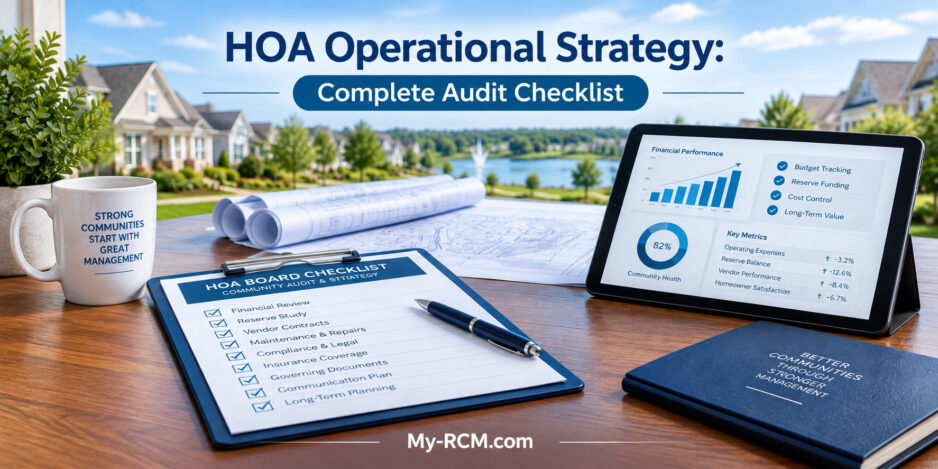
The HOA Operational Health Audit Checklist
Use this actionable framework during your next planning session to evaluate operational health and target necessary improvements:
1. Legal & Regulatory Compliance
- Covenants, bylaws, and design guidelines are organized, digitized, and accessible to all homeowners.
- All amendments and rule changes are properly recorded in the county register of deeds.
- Directors and Officers (D&O) liability insurance is active with adequate coverage limits.
2. Financial Management & Reserves
- Monthly balance sheets, income statements, and bank reconciliations are completed and reviewed by the board.
- Delinquency rates remain below 5% of total annual billed assessments.
- Reserve fund balance matches the recommended funding percentage outlined in the latest professional reserve study.
3. Vendor Management & Operations
- Formal service contracts with detailed scopes of work exist for every contractor.
- Independent vendor insurance compliance is validated annually before invoice payment.
- Work orders are documented, tracked, and inspected before final invoice sign-off.
4. Homeowner Administration
- Architectural review applications follow a written procedure with fixed turnaround deadlines.
- Online payment portal is active with multi-channel payment support for all homeowners.
- A centralized digital communication platform is established to guarantee timely notice distribution.
Elevating Your Community’s Operational Standards
If your board is navigating an intricate developer transition or working to overcome recurring operational hurdles across York County, reach out to Revelation Community Management to discover how experienced local leadership can strengthen your community’s long-term health.
This article is intended for general educational purposes and is not legal advice. HOA laws and legislative requirements can change, and each association’s obligations depend on its governing documents and circumstances. Boards should consult qualified legal counsel regarding specific compliance questions.
Leave a Comment